The Lost Coast

State Route 1 runs along the Pacific Coast for most of California’s length, winding steeply and sharply along some of the world’s most spectacular shores. But about forty miles north of Mendocino, the highway takes an abrupt turn east and joins Highway 101 further inland. The highway leaves the coast because that part of California is so rugged that the highway’s planners simply couldn’t build a road there. Known as the Lost Coast, the area boasts some of the most incredible coastline in the world, with steep cliffs and hills dropping straight into the ocean.

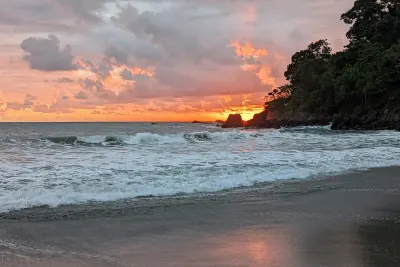
The coast from near the trailhead

The coast from near the trailhead

In late March of 2010, I led a backpacking trip to the area to train new leaders for Stanford’s Pre-Orientation Trips (SPOT). The goal of these so-called Leader Training Trips (LTT) is to prepare our students to lead their own back country trips, specifically for incoming Stanford freshman. We  teach the “hard” skills like navigation, stove use, and rigging shelters, but we also focus heavily on leadership and managing interpersonal issues to make trips run smoothly. As a result, we usually only hike a few miles each day, so we have plenty of time to teach lessons and discuss outdoor leadership. For this trip, we planned a 17-mile, four-day route from Needle Rock Visitor Center to Usal Beach. We planned to leave our cars at Needle Rock. Another group would be hiking the same route in the opposite direction, and we would meet and swap car keys halfway through the trip so each group could leave from the opposite trailhead.

Continue reading “The Lost Coast”

Carson Iceberg Wilderness

See a slideshow with more pictures

About thirty miles south of Lake Tahoe and thirty miles north of Yosemite, the Carson Iceberg Wilderness is a little known gem in California’s high country. Just beyond Bear Valley on Highway 4, the wilderness is past the point at which the road is maintained in winter, making access impossible after the first heavy snows of winter. I led an introductory backpacking trip to Carson Iceberg just before the beginning of the winter season.

The Carson Iceberg Wilderness

The Carson Iceberg Wilderness

Continue reading “Carson Iceberg Wilderness”

Mt. Shasta

See a slideshow with more pictures

Fourteen thousand, one hundred and sixty-two foot Mount Shasta is a dormant volcano that rises in solitary drama in the far north of California. A few years ago, I attempted the climb with my father. We were turned back by low snow, poor conditions, and severe dehydration. Over Memorial Day weekend I tried again with a group of friends from school.

Mount Shasta from Bunny Flat

Mount Shasta from Bunny Flat

We drove to Mount Shasta on Friday afternoon. That night, we camped at Bunny Flat, the trailhead for the popular Avalanche Gulch route at 6950′. Unusually for May, Bunny Flat was still covered in snow. That was a good sign—everything we’d seen and heard suggested that climbing conditions were significantly better than the last time I’d attempted the peak. We pitched a tent on a flat snow patch south of the road, and some of us slept outside on an exposed dirt patch beneath the stars.

Continue reading “Mt. Shasta”

Pyramid Peak

Slide show with more pictures

At 9,983′, Pyramid Peak is the highest point in California’s Desolation Wilderness. Since it is only about a three hour drive from the San Francisco Bay Area, Desolation Wilderness is the most heavily-used wilderness area in the United States. Thus exploring Desolation during the winter months has a number of advantages—not only do the snow-covered peaks make for spectacular vistas, but most of the visitors that swarm the area during the summer are kept away by colder temperatures and feet of snow.

Hiking below Horsetail Falls

Hiking below Horsetail Falls

Continue reading “Pyramid Peak”

Glacier Point Road

Slide show with more pictures

One of the most popular winter activities in Yosemite National Park is skiing or snowshoeing Glacier Point Road. The road is closed to cars in winter beyond the Badger Pass Ski Resort, but most of the road is groomed, making the 10.3 mile road a relatively easy ski route. The reward is a spectacular view of Yosemite Valley.

Yosemite Valley from Highway 49

Yosemite Valley from Highway 49

Continue reading “Glacier Point Road”

Silver Lake

Slide show with more pictures

The winter retreat for the Stanford Outdoor Education Program instructors was a back country skiing trip off of Highway 88 near Kirkwood Mountain Resort. We left campus early on a beautiful Saturday morning. Despite a flat tire in Jackson, we managed to make it to Tragedy Springs Road, of which only the first hundred feet or so had been plowed. We parked in the plowed area and distributed group gear and food. Then we strapped on our skis and went on our way.

John points out our route

John points out our route

Continue reading “Silver Lake”