Taiwan
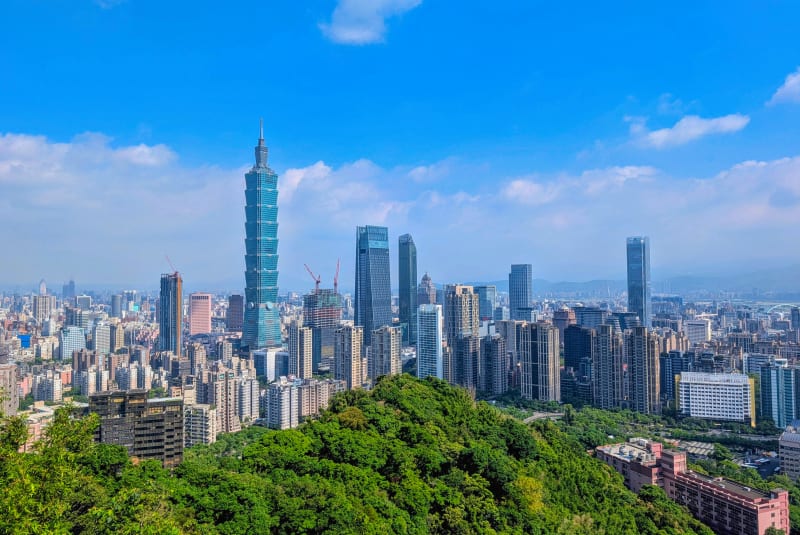
I left my job in mid-May 2026 and suddenly and unexpectedly had two weeks off before starting my new one. On the spur of the moment I decided to visit Taiwan—a compact island packed with steaming volcanoes, centuries-old temples, and some of the best food in Asia—for the first week with my friend Dice and then on my own. I landed in Taipei in the evening, cleared customs, and went looking for an EasyCard, the rechargeable transit pass that makes getting around the city painless. The machine wanted exactly NT$500, but the airport ATMs stubbornly dispensed nothing smaller than NT$1,000 bills, so I grabbed a bowl of beef noodle soup at an airport counter to break one, then rode the Airport MRT into Taipei Main Station and transferred to the Red Line. I checked into the Madison Taipei around 9:30pm and went straight to bed.
In the morning, I joined a walking tour of Taipei’s old town. Our guide led us past the exterior of the National Taiwan Museum and into 228 Peace Memorial Park, home to the Taipei 228 Memorial Museum. Both are dedicated to the 228 Incident, the 1947 uprising that began when a Tobacco Monopoly Bureau agent pistol-whipped a widow for selling untaxed cigarettes and then shot a bystander who tried to intervene. The Kuomintang’s crackdown that followed killed somewhere between ten and thirty thousand Taiwanese and ushered in nearly four decades of martial law now remembered as the White Terror. We also passed the Presidential Office Building, a red-brick, late-Renaissance pile the Japanese colonial government built between 1912 and 1919 that somehow survived a 1945 Allied bombing raid, and wandered through the bustling stalls of Chengzhong Market.

After lunch with the tour group, I walked over to Chiang Kai-shek Memorial Hall, which anchors the east end of Liberty Square, flanked by the National Theater and Concert Hall. Built in 1980 to memorialize Taiwan’s longtime authoritarian ruler, the plaza has since become the symbolic heart of the island’s transition to democracy—the site of the protests that helped end martial law and, decades later, the 2014 Sunflower Movement. I toured the memorial and its museum, then watched the ceremonial changing of the guard.

That evening I joined a food tour of the city. We started with steamed pork buns, then moved on to grilled meat and tofu skewers. A stop at Shi Yun, a 40-year-old fried chicken counter near Shida Night Market, produced some of the best fried chicken and salt-and-pepper tofu I’ve ever had. We chased it with aiyu jelly (a jiggly dessert made from the seeds of a Taiwanese fig) and bubble tea, then kept going: steamed shrimp meatballs, pork rice, pineapple cake, and scallion pancakes.
My friend Dice had arrived the previous evening, so we grabbed breakfast at the hotel and caught an Uber to the Xiaoyoukeng Visitor Center in Yangmingshan National Park. Xiaoyoukeng sits on the flank of Qixing Mountain, Taiwan’s tallest dormant volcano, and its fumaroles hiss sulfurous steam out of a partially collapsed slope—the whole area reeks of rotten eggs. From there we started up the Qixing Mountain Trail. It was a foggy day, and the stony path wound up through thick foliage in a way that felt both beautiful and eerie. We reached the summit just before 10am; the trail’s main draw is its views of Taipei and the surrounding mountains, but the fog meant we could barely see past the ridgeline.

We descended toward the Maipou Trailhead and the park’s main visitor center, then took a bus, tired and sweaty, to the town of Beitou. Beitou sits atop the same volcanic geology that feeds Yangmingshan’s fumaroles, and it’s been Taiwan’s hot spring capital since a German sulfur merchant built a bathhouse there in 1894; the Japanese, who colonized Taiwan the following year, expanded it into a full resort town, and its hot springs are one of only two in the world known to run turquoise with dissolved radium. We rented private baths at the Golden Hot Spring Hotel for a wonderfully restorative post-hike soak.
Back at the hotel to freshen up, we rode the subway to Zhang Men Brewing for a round of excellent Taiwanese craft beer, then, after a short rest, headed to Bar Mood for dinner and a cocktail from its beautifully illustrated menu. We finished the night at Indulge Experimental Bistro, a fixture of Asia’s 50 Best Bars list, for a creative nightcap mixed with house-made tea liqueurs.
The next morning we took the subway to Xinyi District to hike Elephant Mountain, one of the “Four Beasts” that rise abruptly from the city’s southeastern edge (the mountain’s silhouette, from the right angle, resembles an elephant’s head). It was a clear day, which made for spectacular views of the Taipei skyline but also a sweltering climb.

From there we rode the Maokong Gondola, a 30-minute cable car ride over forest canopy and tea plantations, stopping partway at Zhinan Temple, a Taoist holy site founded in 1895 and dedicated to the immortal Lü Dongbin. In Maokong itself we tasted the local Tieguanyin tea and had a mediocre lunch at Big Tea Pot.

Dinner was a different story: a Michelin-starred Cantonese feast at Ya Ge, the restaurant inside the Mandarin Oriental, where the wagyu beef tenderloin, fried rice, and minced pork were all outstanding. Then it was on to Taipei 101, briefly the tallest building in the world (a title it held until the Burj Khalifa surpassed it in 2010). We rode the elevator to the 89th floor shortly before sunset and wandered the observation deck for views of Taipei by daylight and by night, along with a look at the building’s famous tuned mass damper—a 660-metric-ton steel sphere suspended between the 87th and 92nd floors that swings against wind and earthquakes to keep the tower from swaying too far. We capped the night at To Infinity & Beyond, a space-themed cocktail bar with a menu of planet- and satellite-named drinks, for a round of inventive cocktails before bed.

The next day we took a bus to Jiufen, a former gold-mining town in the island’s northeast corner. Gold was discovered in the surrounding hills in the early 1890s, and by the 1930s the town had grown so prosperous under Japanese rule that it was nicknamed “Little Shanghai.” The mines closed in 1971 and the town emptied out, only to be revived decades later after the 1989 film A City of Sadness was shot there; today it’s often (and, as best I can tell, inaccurately) credited as the visual inspiration for Studio Ghibli’s Spirited Away. We walked Jiufen Old Street in the morning before the crowds arrived (and most of the shops opened), then had an excellent tea service at A-Mei Teahouse—a hundred-year-old tearoom, run in the traditional gongfu style, that started life as the owner’s grandfather’s blacksmith shop—where we sampled some of the region’s famous oolong. We walked up to Jiufen Fushan Temple, strolled the old street again (much livelier now that the shops were open), and took a car back to Taipei.

In the afternoon I visited Lungshan Temple on my own. Built in 1738 by Fujianese settlers and dedicated to the bodhisattva Guanyin, the temple’s main hall was destroyed by Allied bombing in 1945—though the statue of Guanyin survived unscathed on her lotus pedestal—and today it houses more than a hundred Buddhist, Taoist, and folk deities. That evening we had an amazing dinner at Tajimaya Shabu Shabu, then visited the Kavalan Whisky Bar to taste some delicious Taiwanese whiskies; Kavalan, distilled in nearby Yilan County, has racked up nine World Whiskies Awards titles over the past decade, an improbable feat for a distillery that’s barely two decades old.
The next morning we took the train down Taiwan’s east coast to Hualien, then boarded a bus into Taroko Gorge—Taiwan’s answer to the Grand Canyon—and on to our hotel, the beautiful Silks Place Taroko. The gorge is stunning, but its infrastructure is still recovering from the 7.4-magnitude earthquake that struck just offshore in April 2024; typhoons and heavy rain in the years since have compounded the damage, and many of the gorge’s trails and attractions remain partially or fully closed. After checking in, I walked up to Xiangde Temple, a white-pagodaed complex perched dramatically above the gorge across the Liwu River, then treated myself to an excellent massage and spent the evening at the hotel pool.

The next day we set out to hike the open portion of the Lushui-Wenshan Trail. We initially walked to the wrong end of it, though we still got some good views of the canyon along the way; retracing our steps to the correct trailhead, we found the open stretch underwhelming. Back near the hotel, I explored some of the walking trails above Tianxiang before spending the afternoon at the pool.

From Taroko we took a bus out of the gorge to Hualien Station and caught a train south to Chishang, a town popular with domestic tourists but rarely visited by foreigners—which meant almost no English was spoken. That became a problem when we arrived to find no taxis waiting and no way to reach our hotel, though the hotel shuttle eventually turned up after a nervous wait. We reached the Papago International Resort in the early evening; it was still brutally hot, so I cooled off in my private pool before dinner at the hotel buffet.
The next morning I rented a bike and rode through Chishang’s famous rice paddies along Brown Boulevard, a road that owes its nickname to a Mr. Brown coffee commercial filmed there in the late 2000s. I stopped at the Great View Pavilion and the Chishang Huge Waterwheel, and paid a visit to the Takeshi Kaneshiro Tree, a bishop wood that became a minor national landmark after the actor filmed an EVA Air commercial beneath it in 2013. From there I biked on to Dapo Pond, a 28-hectare wetland ringed by willows and reeds, and circled its edge taking in the water lilies and the birdlife.

In the afternoon we drove out to Yushan National Park, stopping at the 50-meter Nanan Falls and hiking out to the Shafeng suspension bridges, the second of which offers the best view of the falls below. That evening we took a cab into Chishang town for an excellent dinner at a hole-in-the-wall noodle shop where no one spoke English (thank goodness for Google Translate). We’d hoped to find somewhere for a drink afterward, but Chishang has only two bars, and both were closed on a Monday night, so we settled for a tea and mochi dessert at 田味家-牛汶水 instead.
Dice’s trip ended in Chishang, and I set off alone for the long ride south and around the island. I spent most of the day on the train, riding through Taitung and around Taiwan’s southern tip before heading back north up the west coast, changing trains at Kaohsiung and continuing on to Chiayi, the historic gateway to Alishan. It was a long trip, but the seats were comfortable and the views of the coast and mountains were lovely. From Chiayi, I took a car up into the mountains to my hotel, the gorgeous Hotel Indigo Alishan, and had a delightful cocktail at the hotel bar—the Alishan Tea Time, made with oolong tequila, elderflower liqueur, Sky Moon plum liqueur, and pineapple and lemon juice.

I woke up early to catch one of Alishan’s famous sunrises, a spectacle so renowned that it draws crowds to elevated viewpoints across the region to watch the sun rise over a sea of clouds—one of Taiwan’s official “Eight Scenic Views.” After a short nap, I rode the hotel shuttle up to Alishan National Forest Recreation Area and wandered among its ancient red cypresses; logging during the Japanese colonial era wiped out most of the original stands, and fewer than 40 of the ancient giants remain, some of them well over a thousand years old. I spent the rest of the afternoon at the hotel’s rooftop pool and hot tub, watching the sunset.

After another gorgeous sunrise, I drove to Sun Moon Lake, Taiwan’s largest body of water and the traditional home of the Thao people, one of the island’s smallest recognized indigenous groups. I rented a bike and rode the lakeshore, taking in the views, then visited Wenwu Temple, a hillside complex dedicated to Confucius and the god of war that was built in 1938 by merging two smaller temples that had been submerged when the lake’s dam was completed. I checked into my hotel, the absolutely incredible Grand Hilai Sun Moon Lake, and spent the evening at its rooftop pool and hot tub, which have their own stunning views over the water, before a delicious steak dinner at the hotel restaurant.

In the morning I took a boat cruise around the lake, stopping at Xuanguang Temple, a small Buddhist shrine on the southern shore that holds relics associated with Xuanzang, the seventh-century monk whose pilgrimage to India inspired Journey to the West. Then I caught the high-speed rail back to Taipei and made my way to the National Palace Museum to see its extraordinary collection of Chinese imperial artifacts, including the Jadeite Cabbage—a Qing-dynasty carving, likely a wedding gift, that uses the stone’s natural coloring to render a napa cabbage so convincingly that two insects hidden among the leaves look ready to hop off. It fled the Forbidden City for Taiwan amid the chaos of Japanese invasion and civil war in the mid-twentieth century and has lived in Taipei ever since. I finished the day at the Kavalan Whisky Showroom, picking out a bottle to bring home.

The next morning, I flew home, tired, well-fed, and already thinking about what I’d missed.